

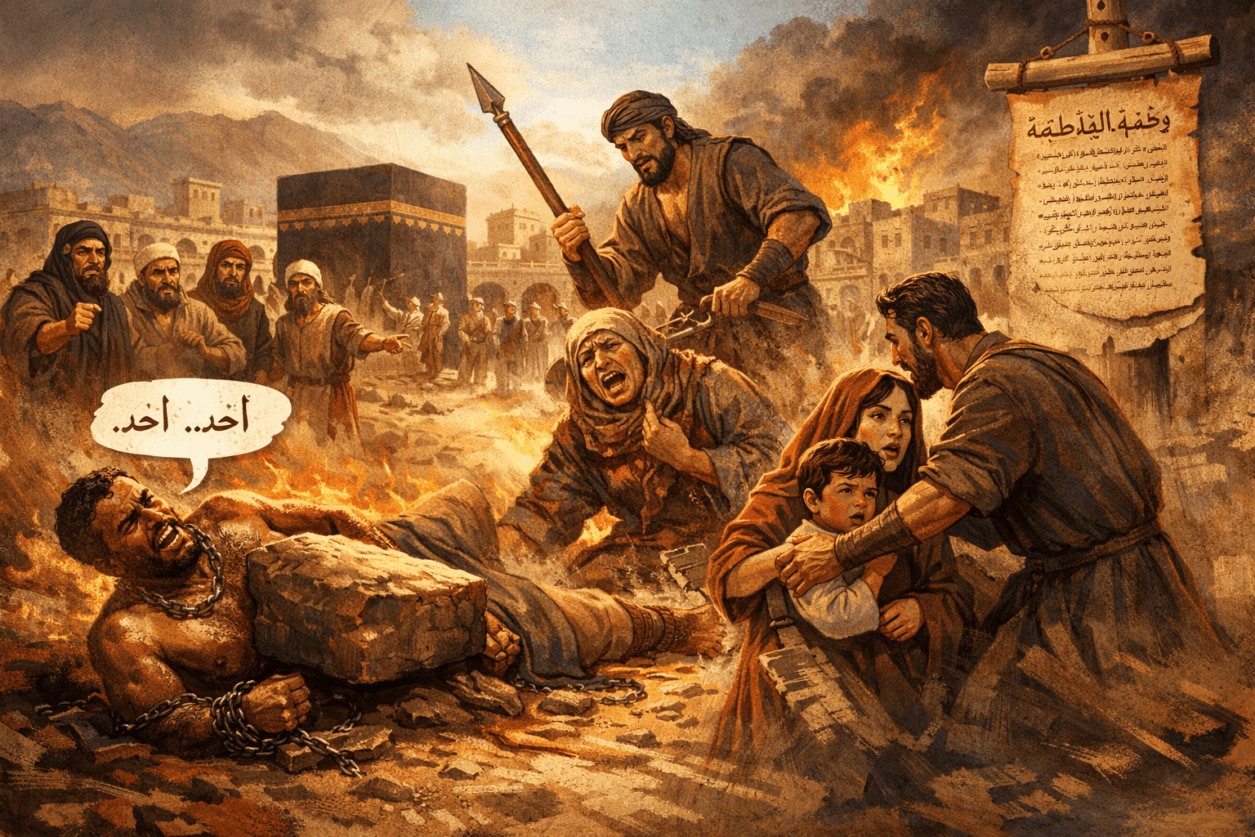
Before the Hijrah: Faith Was Under Fire in Makkah
Before the Hijrah reshaped the course of Islamic history, the early Muslim community endured years of relentless persecution in Makkah. What began as mockery and ridicule soon escalated into open violence, social isolation, and murder. For the first Muslims, believing in one God was not a private conviction, it was a public risk that demanded extraordinary courage.
As the message of Islam spread, the Quraysh saw it as a threat to their power, traditions, and economic dominance. Unable to silence the Prophet Muhammad ﷺ through persuasion, they turned to intimidation. Muslims were tortured publicly in the streets of Makkah, their suffering intended as a warning to others who might consider following the new faith.
Among the most haunting examples was Bilal ibn Rabah (RA), dragged across burning sand and crushed beneath heavy stones, his only response a repeated declaration of faith: “Ahad, Ahad”—One, One. Even more harrowing was the fate of Sumayyah bint Khayyat (RA), an elderly woman who refused to renounce Islam and was brutally killed, becoming the first martyr in Islamic history. Her death marked a painful truth: faith in Allah could cost one’s life.

Persecution was not limited to physical abuse. Families were torn apart as parents disowned children, spouses were forced to separate, and tribal protection was withdrawn. Converts lost their livelihoods, were denied trade, and became social outcasts overnight. The Quraysh later imposed a full economic and social boycott on the Prophet’s clan, confining them to a valley where hunger and deprivation became daily realities. Children cried from hunger, and survival itself became a test of faith.
Yet through all of this, the Prophet ﷺ remained remarkably patient. He did not permit retaliation, nor did he allow anger to guide decisions. Instead, he taught his companions resilience, reminding them that hardship was not a sign of abandonment by Allah, but often a precursor to divine support. His response reflected a deep trust in Allah’s wisdom and timing.
This patience was not passive. It was purposeful restraint strength under control. The Prophet ﷺ continued to preach, to console the oppressed, and to seek lawful means of protection. Some Muslims were permitted to migrate temporarily to Abyssinia, where a just Christian king offered refuge. Still, the Prophet ﷺ remained in Makkah, enduring hardship alongside his people.
The turning point came when the Quraysh crossed a final line. Frustrated by the continued spread of Islam, they gathered and plotted to assassinate the Prophet ﷺ. Representatives from multiple tribes agreed to strike together, hoping to avoid blame and end the message once and for all. It was at this moment—when danger was most imminent—that Allah granted permission for migration.
The command to migrate was not an escape born of fear, but a strategic and divinely guided transition. It marked the end of one phase of the Islamic mission and the beginning of another. The Hijrah would lead not only to safety, but to responsibility—the establishment of a community, a society, and eventually a state built on justice, worship, and moral accountability.

Understanding the persecution that preceded the Hijrah is essential to understanding its significance. Migration did not come easily, nor was it undertaken lightly. It was preceded by years of sacrifice, unwavering patience, and trust in Allah under the harshest conditions. Every step toward Madinah was paved with the suffering of those who held firm when faith was tested most severely.
The story of Hijrah, therefore, does not begin on the road to Madinah. It begins in the streets of Makkah—with bruised bodies, broken families, and unshaken belief. It begins with people who had every reason to give up, yet chose instead to remain faithful, waiting for Allah’s command.
Their endurance remains a powerful reminder for Muslims today: meaningful change often requires patience before movement, faith before relief, and trust before victory.
Follow our January Reflection’ Series here