

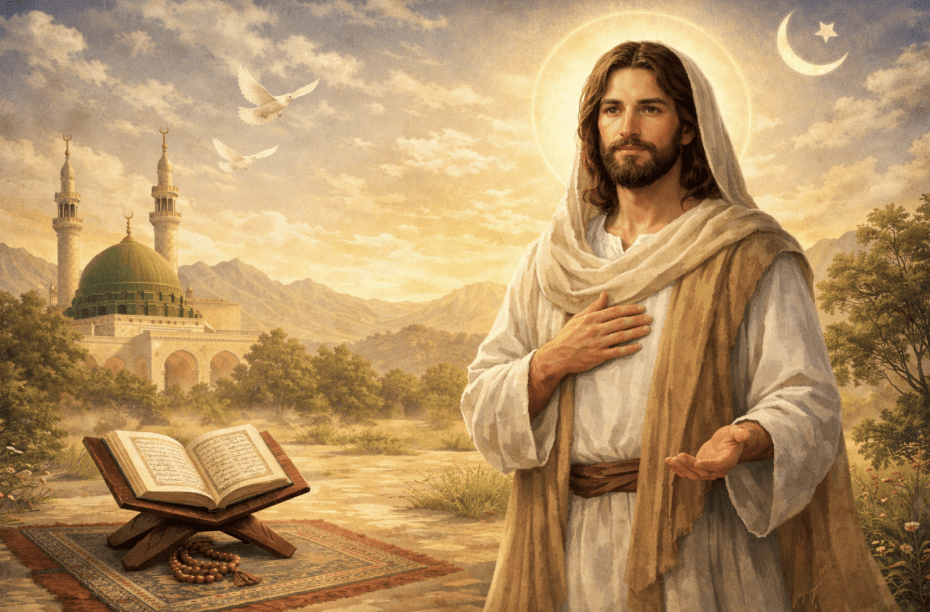
For many people, Jesus is most closely associated with Christianity. Yet in Islam, Jesus—known as ʿIsa ibn Maryam (Jesus, son of Mary) holds an honoured and deeply spiritual place. Far from being a marginal figure, Jesus is one of the most revered prophets in Islam, mentioned frequently in the Qur’an and respected by Muslims around the world. Jesus in the Qur’an Islam teaches that Jesus was one of the greatest messengers sent by God (Allah).
The Qur’an affirms his miraculous birth, stating that he was born to the Virgin Mary (Maryam) by God’s command alone. In fact, Mary is so highly esteemed that an entire chapter of the Qur’an—Surah Maryam—is named after her. Muslims believe Jesus performed miracles by God’s permission: healing the sick, giving sight to the blind, raising the dead, and speaking as an infant to defend his mother’s honor. These miracles are signs of God’s power, not proof of Jesus’ divinity. While Islam strongly honors Jesus, it differs from Christian theology in key ways.

Muslims do not believe Jesus is the Son of God or part of a Trinity. Instead, Islam emphasises strict monotheism, teaching that Jesus was a human prophet who called people to worship the One God. The Message of Jesus in Islam In Islamic belief, Jesus preached compassion, humility, justice, and devotion to God—values that resonate deeply within Muslim ethics.
“The Messiah, Jesus, the son of Mary, was only a Messenger of Allah, and His word which He directed to Mary, and a soul [created] by Him.”
— Qur’an 4:17
He is seen as a continuation of the prophetic tradition that includes Abraham, Moses, and later Muhammad (peace be upon them all). The Qur’an also teaches that Jesus was not crucified, but that God raised him up, protecting him from his enemies. Muslims believe that Jesus will return near the end of time as a sign of the Day of Judgment, restoring justice and defeating oppression before the final hour. Islam does not have a formal religious holiday celebrating Jesus’ birth, such as Christmas. Muslims generally do not celebrate birthdays of prophets, including Jesus or even the Prophet Muhammad pbuh (though some cultural practices differ).
“She said, ‘How can I have a son when no man has touched me?’
He said, ‘Thus it will be; Allah creates what He wills.’”
— Qur’an 3:47
However, honoring Jesus in Islam is expressed in other meaningful ways: Daily respect and prayer language: When Jesus’ name is mentioned, Muslims often say “peace be upon him.”
Stories of Jesus and Mary are regularly recited and studied, especially during religious learning and reflection. Muslims strive to embody the compassion, humility, and righteousness that Jesus represented. Many Muslims acknowledge and respect Christians’ love for Jesus, seeing him as a shared figure who can build understanding between faiths.
Jesus and Muslim Views on Christmas While Christmas is not a religious celebration in Islam, many Muslims still show cultural respect—wishing neighbours well, participating in family or community gatherings, or acknowledging the season’s message of peace and goodwill. This reflects Islam’s emphasis on kindness, coexistence, and honoring shared values. A Bridge Between Faiths Jesus occupies a unique role as a bridge between Islam and Christianity.
“Indeed, I am the servant of Allah. He has given me the Scripture and made me a prophet.”
— Qur’an 19:30
His story in Islam highlights shared beliefs—his miraculous birth, moral teachings, and special status—while also reflecting theological differences. For Muslims, loving and respecting Jesus is not optional; it is an essential part of faith. In a world often divided by misunderstanding, the Islamic view of Jesus offers a powerful reminder: faith traditions can differ while still honoring the same figures, values, and hopes for justice, mercy, and peace.