

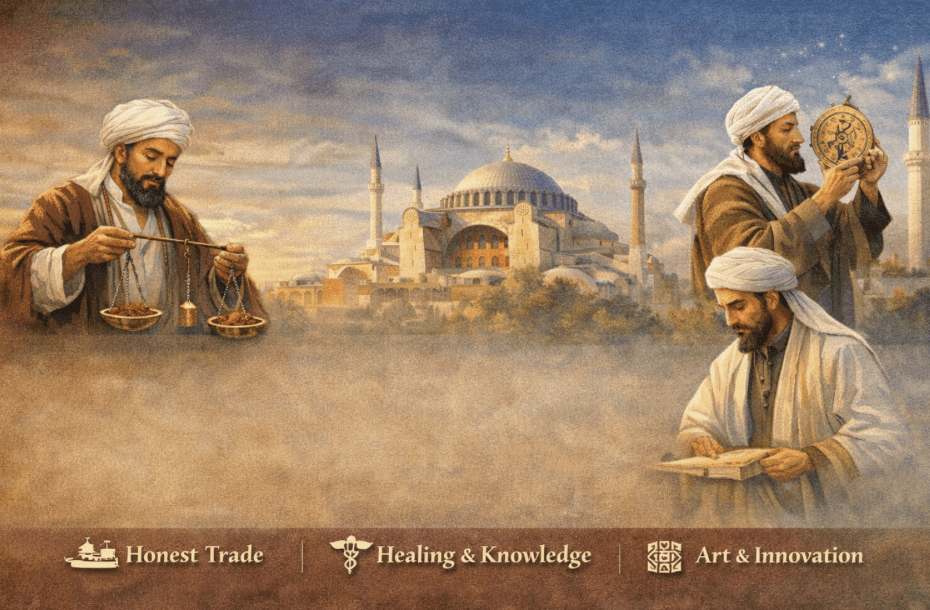
Across Islamic history, professions were never viewed as separate from faith. Skill, integrity and service were central to how belief was lived and understood. Islam emerged in a society deeply shaped by trade, and its earliest followers were active participants in economic and social life. From traders and physicians to architects, calligraphers, mathematicians and entrepreneurs, Muslim craftsmen and professionals shaped societies not only through innovation, but through the ethical values they carried into their work.
From the outset, faith has always been rooted in work and ethics – not expressed only through prayer, but through conduct. It was often the visible ethics of Muslim professionals – traders, craftsmen, scholars and healers – that carried the message further than words ever could. This helps explain how a message that began in seventh-century Arabia came to be embraced today, by nearly two billion people – across vastly different cultures. Its spread was shaped less by force or coercion, but by everyday encounters grounded in trust, reliability and integrity.
The Merchant as a Model of Morality
Commerce occupies a central place in Islamic history. The Prophet Muhammad ﷺ was a trader long before prophethood, and his reputation for honesty earned him the title al-Amin — the trustworthy.
Another prominent example is Khadijah (RA) a formidable businesswoman in Makkah who managed large trading enterprises spanning Arabia and beyond. She employed men to trade on her behalf, negotiated contracts, and built wealth through trust. Her success challenged assumptions even in her own time, pioneering for Muslim women as leaders in commerce.
This ethic later shaped Islamic legal and commercial systems. Scholars such as Imam Abu Hanifa – himself a merchant – developed rulings on contracts, wages and accountability, ensuring that faith governed economic life as much as private worship.
As Islam spread, Muslim merchants were often welcomed into foreign ports precisely because of their reliability, thus trade became a form of da‘wah. In East Africa, India and Southeast Asia, traders from Hadramout became known for fair weights, honest pricing and respectful conduct. They carried spices, textiles and goods – but they also carried admirable values.
Science, Craft and the Pursuit of Excellence
This same ethic extended into science, craft and intellectual life. Islamic civilisation placed immense value on knowledge and skill, viewing them as pathways to understanding the Creator. Scholars, physicians and artisans approached their professions with the belief that excellence was a moral responsibility.
Among the most influential figures was Ibn Sina (Avicenna), widely regarded as one of the most significant physicians in medical history. His Canon of Medicine was a standard reference in Europe for centuries. For Ibn Sina, studying the human body was a means of recognising divine wisdom; medicine was not merely technical skill, but a moral vocation requiring compassion and integrity.
Mathematics was similarly transformative. Muhammad bin Musa al-Khwarizmi, the ninth-century mathematician, developed algebra (al-jabr), laying foundations for disciplines ranging from architecture and engineering to finance and inheritance law. His influence endures today in the word “algorithm”.
Craftsmanship held equal weight. The Qur’an repeatedly urges believers to reflect on precision and balance, concepts deeply embedded in Islamic art and architecture. Artisans such as Ibn Muqla, the tenth-century calligrapher, transformed handwriting into a disciplined visual art governed by geometry and harmony. Architects like Sinan in the Ottoman Empire, and the builders of the Alhambra in Andalusia, combined engineering precision with spiritual symbolism, creating spaces that were both functional and sacred.
Even everyday tools were refined with care. Surgical instruments, water systems and textiles from the medieval Islamic world reveal an understanding that precision and intention were as much moral imperatives as technical skills. Market regulation was institutionalised through the muhtasib, an official responsible for quality and fairness, reinforcing public trust in professional life. To make something well – whether a text, a tool or a building – was to honour both the Creator and the community.
Cultural practices reflected the same principles. Yemeni Sufi Muslims popularised coffee in the fifteenth century to sustain night prayers and study. Early coffeehouses became centres of learning, discussion and community cohesion, blending spiritual devotion and social entrepreneurship.
Muslim Presence in Britain: Professions and Belonging
Centuries later, this tradition echoed across Britain. Muslim engagement in the UK has been shaped by work and contribution, rather than isolation. Muslim sailors worked in British ports from the eighteenth century onwards, while traders and skilled workers formed some of the earliest Muslim communities in cities such as London, Cardiff and Liverpool.
In the late nineteenth century, Abdullah Quilliam, a Liverpool solicitor, became one of the most significant figures in British Muslim history. After embracing Islam, he used his legal expertise to defend Muslim sailors, publish legal opinions, and establish Britain’s first mosque and Islamic institutions. His professional credibility helped bridge faith and public life, demonstrating that Muslim identity and British civic engagement were not in conflict.
Post-war migration in the twentieth century further transformed this presence. Muslim communities arrived primarily as labourers, filling gaps in factories, foundries and transport. Many established small businesses, including shops, cafés and textile stores, became community hubs rooted in service.
A Living Legacy
From the markets of Makkah to the ports of Britain, often it was not preaching but practice that carried Islam across the world. Faith spread through contracts honoured, tools crafted with care, knowledge pursued with humility, and work carried out with integrity.
The history of Muslim professions is not confined to manuscripts or monuments. It is alive in modern Britain: in NHS doctors and nurses serving patients with compassion, in architects designing inclusive spaces and masjids, in shopkeepers providing honest service, and in educators shaping young minds.
From Khadijah’s trade networks to Ibn Sina’s medical texts, from al-Khwarizmi’s algebra to Sinan’s architecture, and from Yemeni coffee traders to Abdullah Quilliam’s legal practice, a consistent thread emerges: faith expressed through skill, integrity and public contribution. Ethical, high-quality work is an enduring expression of faith – as relevant in Britain today as it was in the streets of Makkah, the courts of Istanbul, or the ports of Yemen centuries ago.