

After the international success of her debut novel As Long as the Lemon Trees Grow, award winning Zoulfa Katouh returns with a new young adult release that blends grief, identity and magical realism into a story that feels both intimate and expansive. Her latest novel, The Ocean Would Paint Me Blue, arrives with the same emotional intensity that defined her first book—but this time, the focus turns inward, into the private landscapes of loss, colour, and memory.
At the centre of the story is seventeen-year-old Jihad Dabbagh, an aspiring artist whose world shifts irreversibly after the death of her mother. In Katouh’s universe, grief does not only reshape emotion—it alters perception itself. Jihad wakes to a world drained of colour, where vibrancy has been replaced by a persistent, suffocating grey.
“She loses the ability to see colour after her mother’s death,” Katouh explains. “For her, it’s not entirely surprising because the women in her family have always carried these blessings. But what follows is her journey of reclaiming those colours again.”

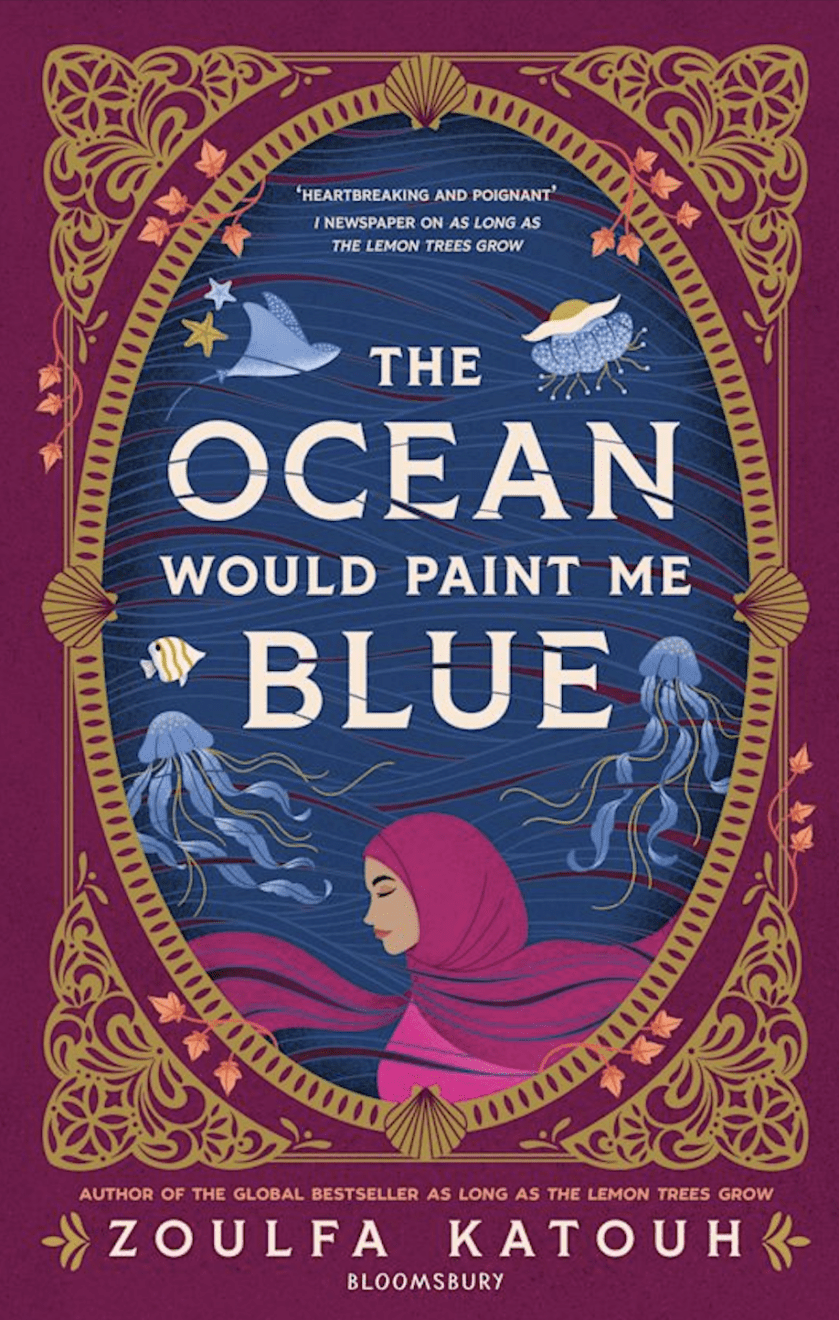
That idea of inherited “blessings” is central to the novel’s magical realism. Jihad comes from a line of women who carry extraordinary abilities: her mother could communicate with sea creatures and breathe underwater, while Jihad’s own gift once allowed her to experience colour in a heightened, almost synaesthetic way. But grief disrupts that lineage. What was once wonder becomes absence.
The story moves from this deeply personal loss into a new environment: an elite school in New York City, where Jihad finds herself the only visibly Muslim student. The transition is not just cultural but confrontational. She faces isolation, subtle exclusions, and overt Islamophobia while trying to navigate a grief that no one around her fully understands.
Yet Katouh resists framing the story purely through suffering. Instead, she anchors Jihad’s experience in art—specifically, an old sketchbook left behind by her mother. What begins as a private act of remembrance becomes something far more extraordinary. Drawings that Jihad creates begin to appear as large-scale murals across the city, transforming New York’s walls into living archives of memory, emotion and resistance.
Art, in this sense, becomes both language and rupture. It is how Jihad speaks when words fail, and how she begins to reassemble herself in a world that feels stripped of meaning.
While Katouh’s debut explored survival against the backdrop of war, The Ocean Would Paint Me Blue shifts its lens toward more everyday but equally urgent struggles: grief, identity, and belonging in spaces that do not always make room for difference.


“What Jihad goes through is something that a lot of people can identify with,” Katouh says. “We all go through difficulties in our lives. We all experience our own struggles to become better versions of ourselves.”
One of the most striking aspects of the novel is its unapologetic portrayal of Muslim identity. Jihad’s faith is not incidental; it is foundational. Her name, her hijab, her daily practices—all are woven into the fabric of who she is, rather than treated as narrative explanation or cultural backdrop.
“I wanted to show how proud she is of her faith,” Katouh says. “Her identity—from her name to her hijab—is central to who she is. I wanted Muslim readers to know that they don’t have to be shy or embarrassed about who they are or where they come from.”
That insistence on visibility is part of Katouh’s broader storytelling philosophy. For her, fiction is not only a creative act but a bridge between experiences.
“Stories bring people together,” she reflects. “They’re a gateway to understanding experiences different from our own. They make the world feel both bigger and smaller at the same time.”
Visually and thematically, the novel is steeped in magical realism, with influences that fans of Studio Ghibli may recognise: everyday life subtly disrupted by the extraordinary. Colour becomes memory, murals become messages, and grief itself becomes something that can be seen, almost touched.
Katouh describes herself as drawn to that intersection between the ordinary and the impossible. “I’ve always loved magic and the unknown,” she says. “I’ve always wanted to add something extra to my stories because that’s how different people experience the world.”


Even the title, The Ocean Would Paint Me Blue, emerged from a quiet moment within the manuscript. It evolved gradually, shifting through iterations until a single line—Jihad imagining a future where the ocean would paint her blue—anchored the entire novel.
“It went through many different versions,” Katouh recalls. “Then my editor found a line where Jihad imagines a future where the ocean would paint her blue. She felt it captured everything Jihad is and wants to become.”
Behind the novel’s luminous imagery lies a writing process that was, unexpectedly, swift. Where her debut took a year to complete, this book came together in just three months. Yet Katouh describes the emotional labour as just as demanding.
“Writing made me confront feelings I didn’t even realise I was carrying,” she says. “Sometimes I’d write a line and think, ‘That’s exactly how I feel.’ Writing is a form of catharsis. You discover yourself the more you write.”
As readers prepare to step into Jihad’s world, Katouh is already at work on her next project. Details remain closely guarded, but she hints that it will continue her exploration of transformation and loss.
“It’s about the death of girlhood and what that means,” she says.
For now, The Ocean Would Paint Me Blue stands as a story about what remains after everything familiar disappears—and what begins to return, slowly, when it seems least possible. It is a novel that suggests colour is not lost forever, only waiting to be seen again.